The Silent Skill Gap: Why AI Won't Replace HR Professionals—But AI-Literate HR Professionals Will
Artificial Intelligence is transforming Human Resources at a remarkable pace. Recruitment software can screen thousands of resumes in minutes. Chatbots answer employee questions instantly. Predictive models estimate employee turnover before resignation letters are written.
These innovations have led many professionals to wonder whether HR is becoming one of the first business functions to be replaced by AI.
The reality is more complex.
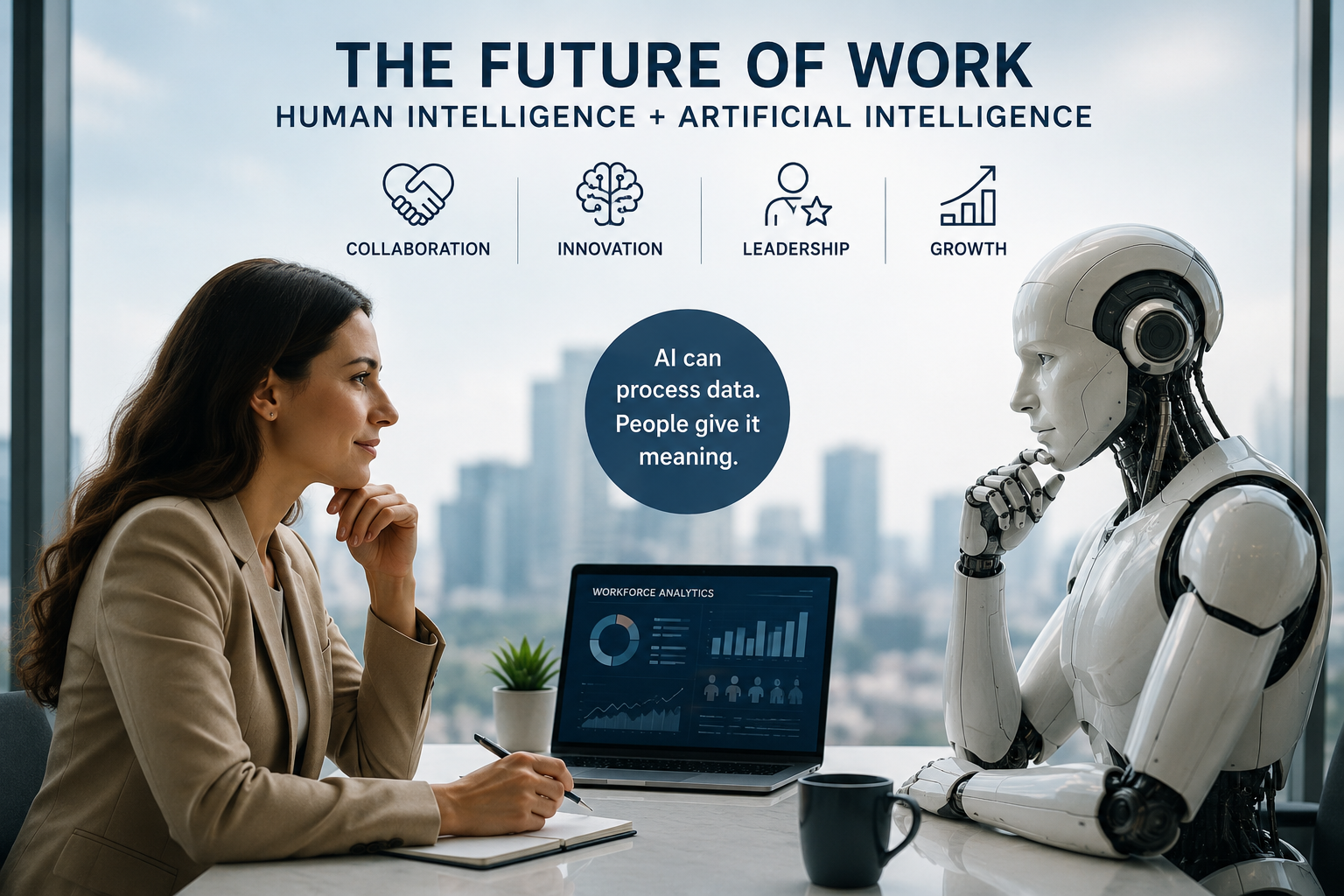
The greatest disruption is not the automation of HR tasks. It is the emergence of a new type of professional—one who can combine human judgment with artificial intelligence.
The Invisible Divide
Most discussions focus on jobs that AI might eliminate. Far fewer discuss the professionals who may become invisible.
In many organizations, two HR professionals may have the same degree, similar experience, and identical job titles. Yet one uses AI to analyze workforce trends, generate reports, identify hiring bottlenecks, and make faster decisions, while the other relies entirely on traditional methods.
Their job descriptions remain the same.
Their productivity does not.
This invisible divide is becoming one of the biggest competitive differences in modern workplaces.
From Administrative HR to Intelligence-Driven HR
For decades, HR has been associated with administration—payroll, compliance, attendance, and documentation.
Today, organizations expect HR teams to contribute directly to business strategy.
Leaders no longer ask only, "How many employees do we need?"
They ask:
- Which skills will become obsolete in three years?
- Which departments are at risk of burnout?
- Which employees are most likely to become future leaders?
- What capabilities should we hire before competitors do?
Answering these questions requires more than experience. It requires data, analytics, and intelligent decision support.
AI is becoming the engine behind those insights.
It is the emergence of a new type of professional—one who can combine human judgment with artificial intelligence.
The Real Skill Gap
The biggest challenge is not learning another HR policy or employment regulation.
It is developing the confidence to work with intelligent systems.
Many professionals hesitate because they believe AI belongs to data scientists or software engineers.
It doesn't.
Modern AI tools require curiosity more than programming knowledge.
Understanding how to ask better questions, interpret AI-generated insights, and recognize biased recommendations will become essential HR competencies.
Human Judgment Cannot Be Automated
Organizations do not succeed because they collect more data.
They succeed because they make better decisions.
AI can identify patterns.
It cannot understand office politics.
It cannot rebuild trust after a difficult restructuring.
It cannot inspire employees during uncertainty.
It cannot replace ethical leadership.
These responsibilities remain deeply human.
As AI becomes more capable, emotional intelligence becomes even more valuable.
A New Career Advantage
The next generation of HR professionals will likely be evaluated on a different set of strengths.
Technical literacy, analytical thinking, business understanding, and adaptability will matter alongside communication, empathy, and leadership.
The professionals who continuously learn will not compete with AI.
They will compete with professionals who know how to use AI effectively.
That distinction may define career growth over the next decade.
Looking Ahead
The future of Human Resources is not about choosing between people and technology.
It is about building organizations where both complement each other.
AI will continue to automate routine work.
Human professionals will continue to provide context, ethics, creativity, and trust.
The question is no longer whether AI will replace HR.
The better question is whether today's HR professionals are preparing for the version of HR that is already beginning to emerge.
Those who embrace that transition will not simply survive the future of work.
They will help shape it.
- Most discussions focus on jobs that AI might eliminate.
- For decades, HR has been associated with administration—payroll, compliance, attendance, and documentation.
- The biggest challenge is not learning another HR policy or employment regulation.
- Organizations do not succeed because they collect more data.
- The next generation of HR professionals will likely be evaluated on a different set of strengths.